
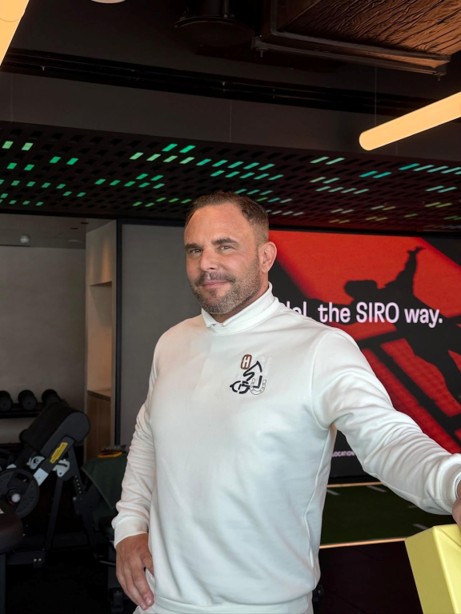
MATTHIAS SIEMS; An unconventional inventor and technology investor explores the future of energy, human imagination, and the convergence of physics and psychology.
The Unusual Mind Behind a Billion-Dollar Vision
There are entrepreneurs who build businesses, scientists who discover new principles, and people who spend their lives trying to connect worlds that others consider unrelated. Matthias Siems presents his professional identity around that third approach.
An inventor, technology investor and founder of NEO 7even, Siems says he has spent more time imagining alternative futures than following conventional definitions of work. He says his first patent concept dates to around age 12 and reports involvement in more than 200 inventions and intellectual-property initiatives spanning medical technology, robotics, energy and aerospace.
For Siems, dreaming is not the opposite of working. It is an early stage of invention: forming a hypothesis, recognizing a pattern and asking whether a technical solution could exist where others see only a limitation.
How a Dreamer Built a Billion-Dollar Enterprise
Siems associates his ventures and intellectual-property interests with an estimated enterprise valuation of approximately US$2 billion. This is a company-provided estimate, not an independently verified assessment of enterprise value or personal net worth. The term “billionaire” should therefore be understood as part of the profile’s positioning rather than a verified wealth ranking.
His investment model centers on scientific concepts and potentially valuable intellectual property. Rather than developing every invention alone, he aims to connect inventors, engineers, laboratories, financiers and commercialization partners. The thesis is that a small number of validated technologies can create value disproportionate to the hours spent generating their original ideas.
Execution remains essential. Patents, prototype testing, manufacturing, regulatory approvals and customer adoption can all require years of disciplined work. In Siems’s philosophy, imagination sets the direction while teams turn a concept into measurable reality.
TAP: The Ambition to Reimagine Distributed Electricity
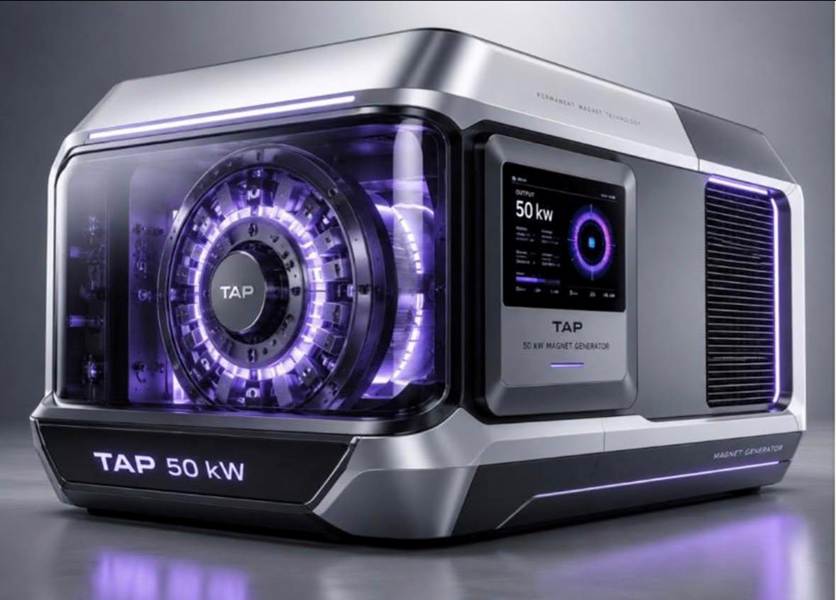
One of the most ambitious projects associated with Siems is TAP, or Total Autonomous Power: a proposed magnetomechanical electricity-generation architecture intended for decentralized applications. Envisioned use cases include remote communities, refugee settlements, rural clinics and sites where grid infrastructure is costly or unreliable.
The project description refers to specially configured permanent-magnet assemblies, including neodymium and samarium-cobalt materials; field-shaping arrays; precision mechanical structures; low-friction or magnetic bearings; vacuum-compatible components; axial-flux alternators; power electronics; supercapacitor buffering; and sensor-based load management. Its stated engineering objectives include reducing friction, managing counter-torque, stabilizing rotational dynamics and converting mechanical movement into electricity.
According to the project team, prototypes have undergone extended technical evaluations involving institutional specialists and international academic participants, with successful results reported. Independent test reports, measured input/output energy balances and certification scopes were not provided for this profile, so those claims should be documented before they are treated as independently established.
The scientific distinction is important: permanent magnets exert forces, but they are not an inexhaustible energy source under established physical laws. Any claim of continuous net electrical output without external energy input requires rigorous, independently reproducible testing and a complete accounting of energy inputs and stored energy. TAP’s proposed autonomous performance remains a claim to be demonstrated, not an accepted physical result.
For Siems, the societal motivation is clear: reliable distributed power, when technically and economically viable, could support lighting, refrigeration, communications, education and small-business activity far from established grids.
From Physics to Psychology: The Next Frontier
Siems believes the next era of innovation will be shaped not only by breakthroughs within individual disciplines but also by the interfaces between them. Physics describes matter, energy, forces and measurable systems. Psychology examines perception, motivation, decision-making and behavior. Neuroscience and cognitive science connect these fields through the physical processes underlying thought and experience.
Artificial intelligence could deepen this convergence. Computational models may help researchers study how people learn, interpret uncertainty, respond to incentives and interact with complex environments. Insights from cognitive psychology may also inform safer human-machine interfaces, more intuitive robotics and more effective scientific collaboration.
Siems is particularly interested in a future in which leadership is less about controlling information and more about directing attention, setting priorities and helping younger teams develop judgment. In this view, imagination generates hypotheses, AI accelerates exploration, and the scientific method distinguishes compelling ideas from verifiable discoveries.
He also points to historical knowledge. He recounts spending time with Buddhist monks in Tibet while exploring the digitization of historical manuscripts for AI-assisted chronological analysis. Patterns across centuries may generate useful questions about present-day behavior, but historical analogies must be tested rather than treated as predictive laws.
Ideas from the UAE, Opportunities for the UAE
Through NEO 7even, Siems is developing a venture-capital concept intended to support young inventors in the United Arab Emirates. The proposed pathway runs from idea submission and scientific screening to funding, prototype construction, independent verification, certification, commercial deployment and eventual exit.
Collaboration with universities and research institutions is central to the plan, alongside an ambition to engage promising students between 14 and 18 through appropriate educational and safeguarding structures. The strategic goal is to retain technical expertise, companies and employment opportunities in the UAE as homegrown ideas mature into products.
His travels in African countries, including Somalia and Sierra Leone, also inform his thinking. Rather than assuming economic development always requires migration to major cities, he advocates infrastructure that helps people create livelihoods where their families already live: electricity, connectivity, local trade and access to wider markets.
A Life Beyond the Laboratory
Siems’s interests extend to regenerative medicine, surgical robotics and aerospace, including concepts for personal-care and cosmetic products designed around the environmental constraints of commercial space travel. He lives in Dubai and enjoys travel, architecture, automobiles and the contrast between demanding technical projects and private life.
The apparent paradox at the heart of his story is that he prizes dreaming while pursuing inventions that must withstand reality. A vision can inspire capital and talent, but evidence determines whether it becomes technology. His defining proposition is not that imagination can replace science; it is that imagination gives science new questions worth answering.
Editorial note: Biographical achievements, valuation, patent counts, institutional test participation and prototype performance are presented as statements attributed to Siems or his organization unless independently verified. This profile is promotional editorial copy, not an independent scientific audit or wealth assessment.